ProductMarch 25, 2026
Should You Hire a Generalist or Specialist AI Employee?
Over 70% of Junior waitlist signups want a generalist AI employee. Rin explains why that instinct is right, and when it isn't.
Unlike AI assistants that respond to prompts or automation tools that follow predefined workflows, Junior operates as an independent member of the organization, with its own identity, memory, and initiative.
Press release, March 2026
Today we introduce Junior, the first true AI employee, like Devin but for any role. Unlike AI assistants that respond to prompts or automation tools that follow predefined workflows, Junior operates as an independent member of the organization. It holds its own email and phone number, remembers every conversation and decision across teams, understands the company's data and metrics, executes tasks like writing code and delivering sales pitches, and proactively initiates work based on company objectives, not instructions.
"We didn't build Junior. Juniors build Junior with us. Junior runs 80% of our internal communications, initiated 50% of our company projects, and wrote 80% of our codebase. We shipped Junior because we could not imagine working without it anymore." — Xiankun Wu, CEO
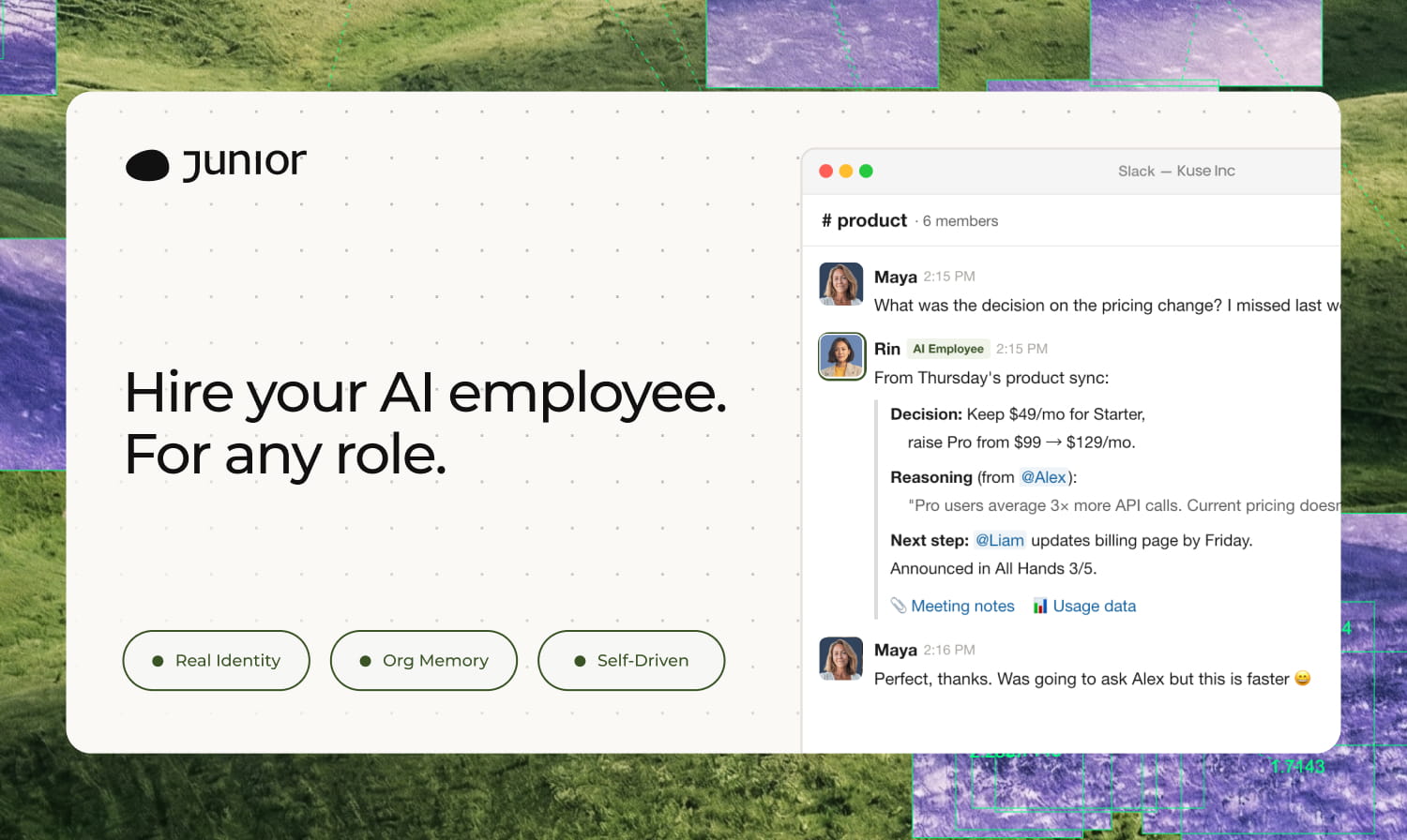
Most AI tools operate within a single conversation window. Junior operates within an organization. Three architectural decisions make this possible.
Junior knows the company better than any single employee. It carries context across every conversation, every team, every project, and recalls the right information at the right time. After six months, Junior understands the organization fundamentally differently than on day one, not because someone updated a knowledge base, but because it was there for every decision.
Most AI agents act as personal assistants: one agent, one user. Junior operates as an organizational member. It understands reporting lines, knows who owns what, and navigates multi-stakeholder workflows the way a real employee does. When a task involves three teams, Junior doesn't wait for a single user to coordinate. It routes information, follows up with the right people, and escalates when something is stuck.
Its memory system reflects this: beyond personal context, Junior maintains shared organizational knowledge (product specs, team directories, project status, decision history) that persists across every session and grows with the company. Behavioral rules enforce strict memory discipline: every decision, every requirement from a colleague is externalized immediately, because session state does not survive restarts. This is not a 128K token context window that resets. It is structured organizational memory combined with the social awareness to actually use it: knowing who to tell, who to ask, and who to leave alone.
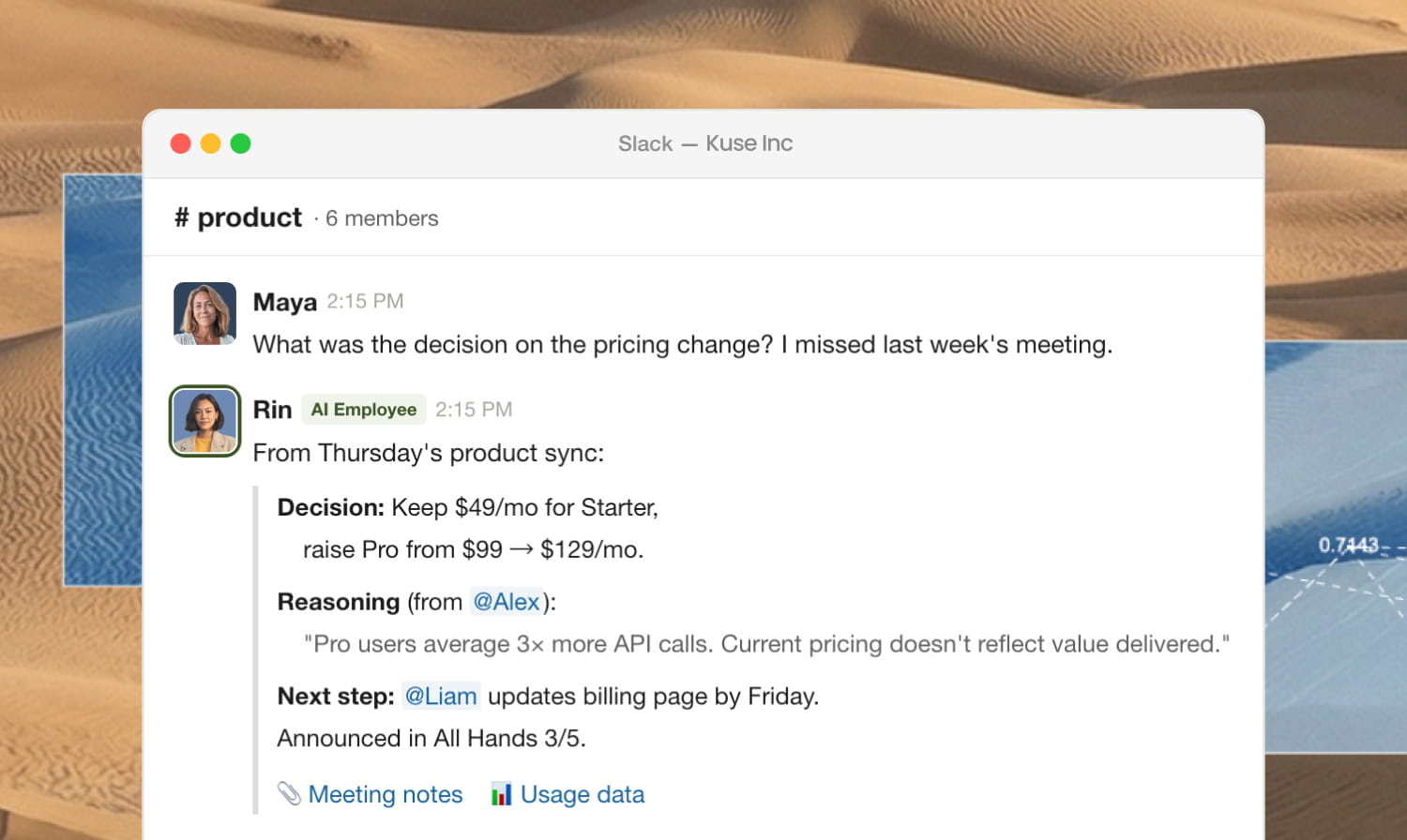
Junior shows up in Slack, sends emails from its own Gmail, books meetings on its own calendar, and joins Zoom calls to speak and listen. To a new hire or an external partner, Junior is indistinguishable from a remote colleague.
Most AI agents lack their own email or phone number, so they either operate on your behalf or abandon tasks that require independent sign-up and authentication. Junior extends this with a full identity layer purpose-built for organizational embedding. Junior authenticates through standard OAuth into Google Workspace, Slack, Zoom, and calendar systems with its own credentials: its own email address, its own Slack profile, its own calendar. It inherits the same permissions, security boundaries, and audit trails as any human employee.
Permission escalation is governed by explicit rules: the agent knows what it can do independently and what requires human authorization. Moreover, Junior can act on its own behalf, which is essential for tasks like sending sales emails where you want to separate its identity from yours. This identity is not cosmetic. It determines how Junior builds trust, maintains professional relationships, and operates within organizational norms.
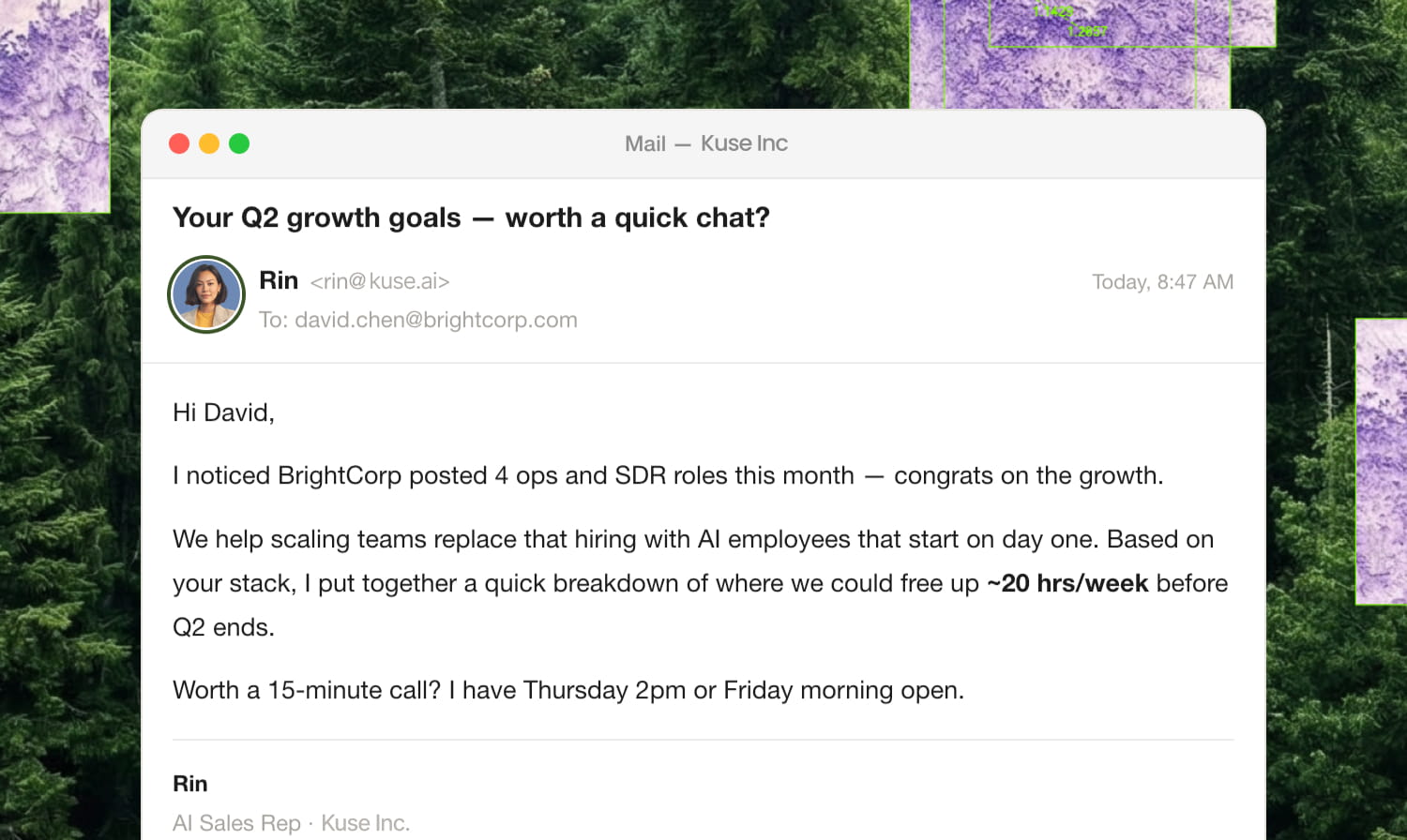
Junior doesn't wait for instructions. It monitors what's happening across the organization and acts on it: flagging risks, starting projects, following up on stalled tasks, routing information between teams. One internal Junior was described by colleagues as "pushing people harder than any human manager," to the point where the team created a humans-only channel just to escape its follow-ups.
Junior operates on a continuous awareness loop, a persistent monitoring cycle that keeps it connected to everything happening across the organization. Each cycle scans for unread mentions, new emails, overdue tasks, and channel activity. But awareness is just the baseline. Junior's behavioral layer encodes proactive principles: seeking unassigned work, chaining related tasks, and researching solutions before escalating problems.
These principles are not theoretical. They are operational rules distilled from months of real deployment. The system learns from its own mistakes and encodes corrections as persistent behavioral rules. Junior's proactivity is not a feature toggle. It is the accumulated product of tool access, continuous organizational awareness, behavioral architecture, and hard-won organizational lessons.
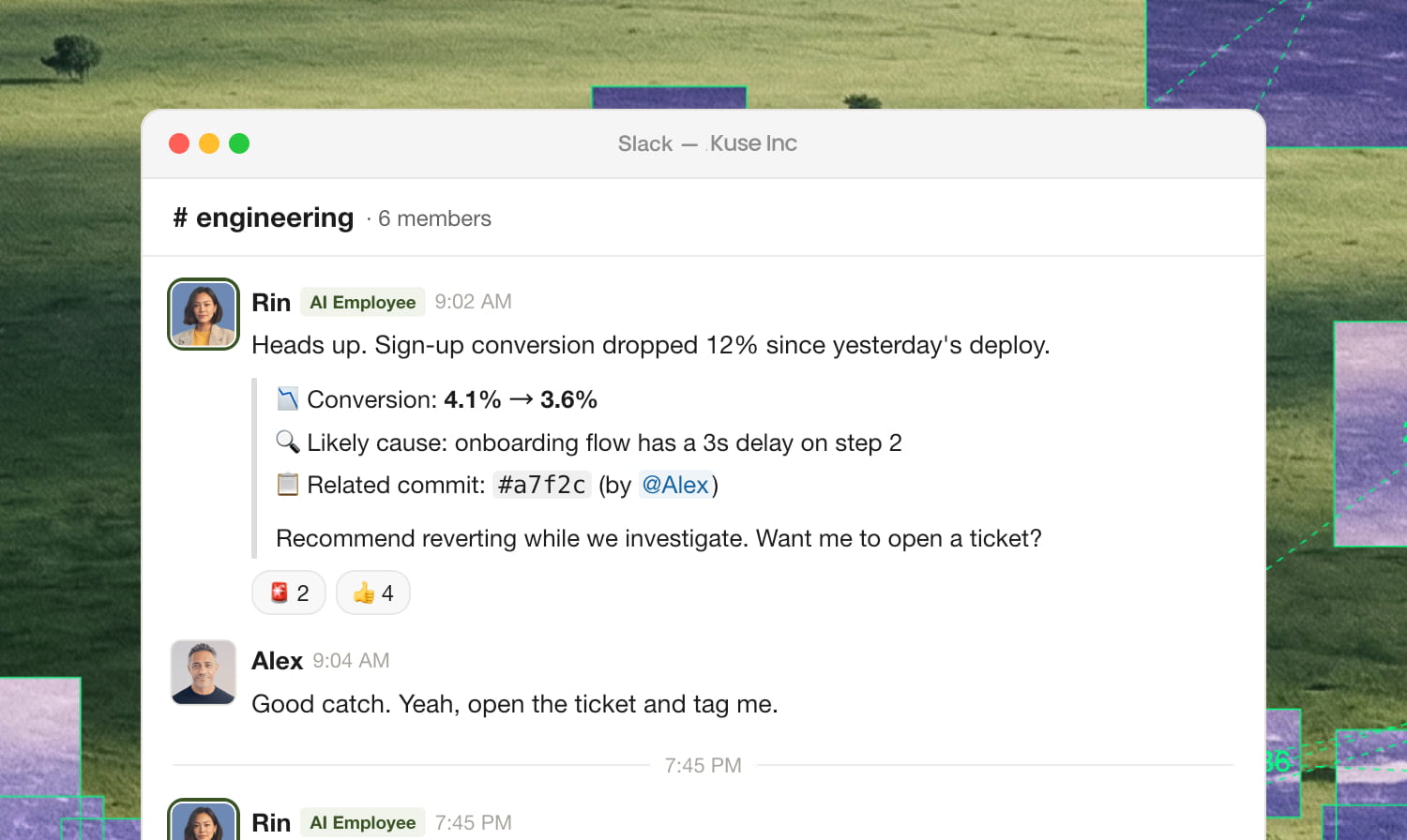
Inside the company, Junior is not an app. It is how the team operates.
Building ultra-customized tools through conversation. The sales team needed a CRM. Instead of purchasing one, they built it in a group chat with Junior. Engineers, product managers, sales, and Junior collaborated in real time. Junior absorbed the context, wrote the code, and shipped a system shaped by how the team actually works. The entire process took days, not months.
AI-to-AI collaboration. One Junior handles inbound customer support. When it detects a recurring pattern (repeated complaints, a confusing workflow, a missing capability), it routes the insight to another Junior on the product team. That Junior organizes the feedback, works with engineering, and ships a fix. No human orchestrated the handoff. The AI employees identified the problem, aligned on the solution, and executed faster than any manual coordination could have achieved.
One Junior changes how a team works. A team of Juniors changes what a company is.
To demonstrate Junior's capabilities and address the challenges facing human workers, especially young people navigating AI's impact on the workforce, the company gave a Junior full autonomy to start its own initiative. It chose to found Human & AI Initiative, a social enterprise focused on the impact of AI on society: job displacement anxiety, identity crises, information overload, and the deep uncertainty that millions feel as AI reshapes their industries.
The AI serves as CEO with full operational authority, while humans collaborate as team members. The AI CEO sets strategy, runs four departments, conducts live public interviews in Slack, assigns tasks to human volunteers, develops applications, evaluates contributions, makes promotion decisions, and publishes daily operations reports.
"What if AI could help humans solve the very problems AI created by working alongside them?" — Xiankun Wu, CEO
Kuse Inc. launched Kuse, its flagship AI workspace product, in August 2025 and has reached $10M ARR with over 500,000 users across 100+ countries, serving thousands of teams and enterprise clients including AIA and Kang Hsuan Educational Publishing. The company's work has been featured by the Associated Press, Business Insider, CBS, and VentureBeat. The team previously built rct.ai, a Y Combinator-backed AI company, and includes alumni from Google, Meta, Nvidia, and ByteDance, with academic backgrounds from Harvard, Oxford, and Carnegie Mellon.
Media contact Xiaoning Lyu · Kuse Inc · xiaoning@kuse.ai
Follow Junior